Choosing Artificial Marble is not a color decision alone. It means matching composition, finish, and fabrication requirements to the room. A polished white slab may brighten a kitchen, yet show scratches or stains more readily than a textured surface. Details matter.
Market growth reflects rising interest, not a guarantee of performance. Grand View Research estimated the global engineered-stone market at USD 23.94 billion in 2023, with projected growth through 2030. The category includes several materials, so its figures should not be treated as Artificial Marble sales alone. For a project, compare the product’s technical sheet: resin content, thickness, water absorption, heat tolerance, stain resistance, and warranty. Ask for a sample and test it under the room’s actual lighting. Read the specification.
Safety deserves attention, too. Some engineered stone contains high levels of crystalline silica, which can create serious exposure risks during cutting and polishing. NIOSH Director Dr. John Howard has warned: “Workers who fabricate engineered stone countertops are at risk of exposure to very high levels of respirable crystalline silica.” Confirm that your fabricator follows current occupational-safety guidance and uses appropriate dust controls. This matters even when the finished surface will be installed indoors.
A useful choice balances appearance with everyday use. For a busy kitchen, ask how the surface responds to hot cookware, acidic spills, and repeated cleaning. For a bathroom vanity, check moisture performance and edge durability. Claims can sound reassuring; independent test results are better. Some compromises remain, and a sample cannot predict every installation condition. This guide explains how to compare options carefully and choose Artificial Marble with evidence, not showroom lighting alone.
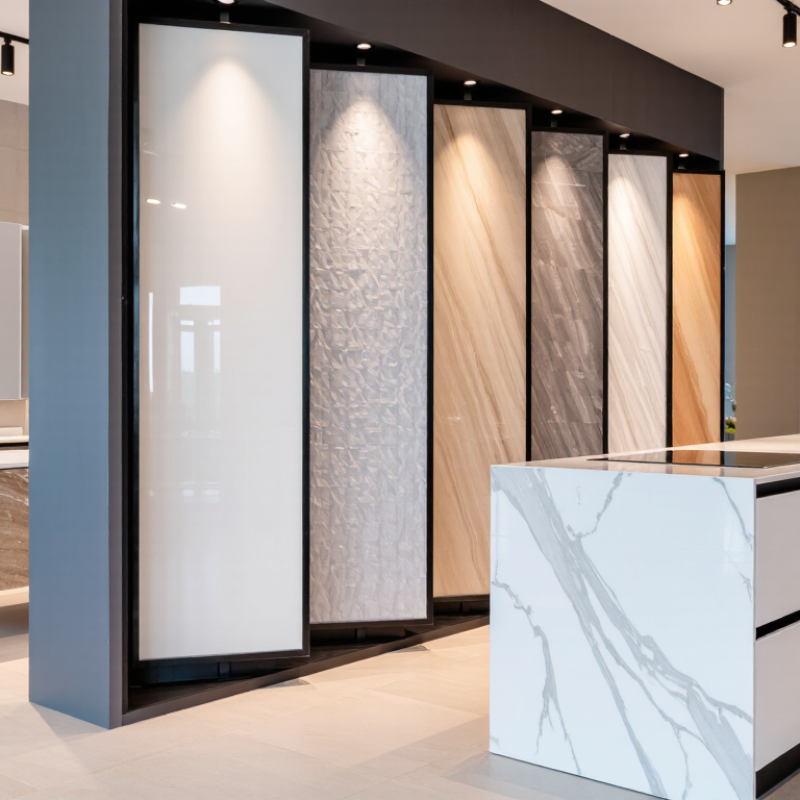
Artificial marble is a family, not one recipe. Cultured marble usually combines marble dust with polyester resin, then forms it in a mold. It suits vanity tops and integrated sinks, with fewer visible seams. Its glossy coating can scratch or dull, though. Acrylic solid surface uses acrylic resin and mineral fillers. It is nonporous and can often be repaired, making small scratches less alarming. Quartz composite is often grouped with artificial marble, but it contains quartz aggregate rather than marble powder. Its veining can look convincing; its composition is different.
Match the material to the room and its daily use. For a bathroom vanity, check stain resistance, edge details, and whether the basin is molded in. For a busy kitchen, ask about heat limits and repair options before choosing by appearance alone. The labels can be blurry, so review the technical sheet.
OSHA’s 2016 silica rule sets an eight-hour permissible exposure limit of 50 micrograms per cubic meter for respirable crystalline silica. That figure matters during cutting and polishing, especially with quartz composite; it is not a measure of a finished countertop’s safety. Fabricators should use appropriate dust controls.
A sample under showroom lights may also look different at home. That detail is easy to miss.
Start by defining where the artificial marble will be installed and how people will use it. A kitchen countertop near a cooktop faces heat, spills, knives, and frequent cleaning. A bathroom vanity may encounter cosmetics, toothpaste, and standing water. Wall panels usually see less impact, but sunlight can affect some finishes. Be specific: note the room, nearby heat sources, likely spills, and daily cleaning habits.
Then match those conditions to the material’s documented performance. Check the technical sheet for heat tolerance, stain resistance, recommended cleaners, thickness, and support requirements. Ask how seams are finished and whether the surface needs periodic care. A sample helps, but inspect it under your project’s lighting; a small swatch may not reveal pattern variation across a long counter. Confirm installation details with the fabricator, especially around sinks and cutouts. Even a careful checklist can miss an awkward edge or maintenance habit, so review the plan before ordering.
Tips: Place a sample beside your cabinets and flooring. Test a hidden area with the cleaner you plan to use, if the supplier permits it. Keep notes; assumptions are easy to forget.
Artificial marble can imitate veined stone, but the pattern may look different across a full countertop. View a large sample in your project’s lighting. Small chips rarely show how veins meet at corners or beside a sink.
Houzz’s 2024 U.S. Kitchen Trends Study reported quartz in 42% of renovated kitchens’ countertop choices; that figure describes quartz, not artificial marble. Popularity is not proof of suitability.
Looks can deceive.
For durability, ask for product-specific test results rather than relying on the word “strong.” ASTM C97/C97M measures water absorption, while ASTM C880/C880M tests flexural strength for stone; these methods can help frame questions, but they do not certify every artificial-marble product.
Ask how the slab handles heat, scratches, and household acids. Resin content and manufacturing vary. Maintenance also depends on the surface: use a soft cloth and mild cleaner, and wipe spills promptly until the supplier confirms the care instructions.
A sample can seem tougher than it is. I would not choose from appearance alone; a warm pan or lemon spill can expose assumptions quickly.
Ask for numbers.
Assess the actual slab in natural and worksite lighting. Artificial marble can show color shifts, tiny pits, or repeated veining that a small sample hides. Small flaws matter. Check several sections, and ask how the surface handles stains, household cleaners, and everyday heat. Performance depends on the material’s composition, so request technical data rather than relying on appearance alone.
Fabrication affects the finished look as much as the slab. Confirm edge profiles, cutout positions, and seam locations before production begins. Veining may not align perfectly across a joint, even with careful planning. Ask the fabricator to dry-fit complex pieces or mark the intended layout on a full-size drawing. Measure twice. Also discuss sink and cooktop cutouts, since narrow sections can be vulnerable during handling.
Installation needs a level, stable base and suitable support, especially around overhangs and large openings. Check that cabinets are secured and the substrate can carry the countertop’s weight. Wall irregularities may require adjustments; don’t assume the slab will conceal them. Clarify who is responsible for measurements, delivery access, seam placement, and final sealing, if the product requires it. A site visit can prevent costly surprises, though it may not catch every issue.
| Assessment Dimension | What to Check | Practical Evaluation | Why It Matters |
|---|---|---|---|
| Material type | Identify whether the product is resin-bound engineered stone, cast cultured marble, or another artificial-marble formulation. | Request the product specification and safety data sheet. Confirm the intended use, such as a countertop, vanity top, wall panel, or floor. | Composition affects appearance, weight, heat tolerance, maintenance, fabrication methods, and installation requirements. |
| Surface and finish quality | Look for an even finish, consistent color, and a pattern that matches the approved sample. Check for visible chips, cracks, pits, or poorly finished edges. | Inspect the full slab or finished piece under suitable lighting. Compare multiple pieces if the project needs a consistent appearance. | Small defects or pattern differences can become more noticeable across large surfaces or joined sections. |
| Thickness and dimensions | Confirm the supplied thickness, finished dimensions, edge profile, and any reinforcement or substrate requirements. | Common slab thicknesses vary by product and market; 12 mm and 20 mm are examples found in some slab products. Use the manufacturer’s specification for the exact material. | Thickness affects weight, edge design, support needs, cutout strength, and compatibility with cabinets or surrounding finishes. |
| Performance for the intended use | Check the manufacturer’s stated limits for heat, moisture, staining, chemical exposure, and UV exposure. | Match the published care and performance information to the actual location. Ask specifically about hot cookware, cleaning products, sunlight, or wet-area use where relevant. | Artificial-marble products differ in performance; a surface suitable for a vanity may not be appropriate for every exterior or high-heat application. |
| Fabrication requirements | Confirm cutting, drilling, edge finishing, seam placement, and sink or appliance cutout details with the fabricator. | Provide accurate templates and appliance specifications before fabrication. Ask how cutouts and narrow sections will be supported and finished. | Careful planning reduces the risk of measurement errors, visible seams, edge damage, and breakage around cutouts. |
| Fabrication safety | Determine whether the material contains crystalline silica or other substances requiring specific handling controls. | Review the safety data sheet and follow applicable workplace rules. Cutting and grinding should use suitable dust controls, such as wet methods where appropriate. | Fabrication can generate hazardous dust. Safe handling protects workers and helps meet local health and safety requirements. |
| Installation and support | Check cabinet or substrate levelness, structural support, access route, joining plan, and any adhesive or sealant requirements. | Have the installer verify site measurements and support conditions before delivery. Confirm who is responsible for plumbing, cooktop, and backsplash coordination. | Proper support and coordination help prevent movement, stress cracks, installation delays, and poorly aligned joints. |
| Maintenance and repair | Review cleaning instructions, recommended cleaners, repair options, and whether sealing is required for that specific product. | Ask for written care guidance and test unfamiliar cleaners in an inconspicuous area only when the manufacturer recommends it. | Following product-specific care instructions helps preserve the finish and avoids damage from unsuitable chemicals or abrasive tools. |
| Project cost and availability | Compare the full installed cost, including material, fabrication, transport, cutouts, edge work, installation, and waste. | Request an itemized quote and confirm lead time, slab or batch availability, delivery access, and replacement-material availability. | The material price alone does not reflect the complete project cost or the time needed to deliver and install the finished surface. |
Artificial marble costs depend on more than the price per square foot. Thickness, surface finish, edge details, cutouts, delivery, and installation can change the final quote. Ask suppliers to itemize these costs, including sink openings and backsplash work. Two quotes may look similar until those details appear.
Compare suppliers on more than price. Ask for a physical sample, care instructions, warranty terms, and examples of completed projects. Check whether the quoted material is consistent in color and pattern across full slabs. A sample helps. Confirm who handles measurement, transport, and installation; unclear responsibility can lead to delays or extra charges. A low quote is not automatically a poor choice, but missing details deserve questions.
Long-term value depends on where the surface will be used. In a busy kitchen, ask about resistance to stains, scratches, heat, and household cleaners. In a bathroom, consider moisture exposure and how seams will be finished. Small gaps matter. Compare the expected maintenance with your schedule and budget, not just the purchase price. Artificial marble can offer a uniform look at a lower cost, but it may not suit every use. I would still request written care guidance before deciding; it is easy to underestimate how daily habits affect a surface.
Compare typical installed costs, supplier types, and long-term value.
Typical U.S. installed cost estimates in USD per square foot. Ranges are indicative, not quotes; region, thickness, cutouts, edge details, and installation complexity affect the final price.
Often supplied by bath and shower-surface fabricators. Its relatively low initial cost suits surrounds and vanity tops; protect the gel coat from abrasive cleaners and scratches.
Look to solid-surface fabricators. Minor scratches can often be sanded out, which may extend useful life; follow the manufacturer’s care guidance.
Usually purchased through countertop fabricators. It is nonporous and generally needs no sealing, but use trivets because resin can be damaged by high heat.
Choose a fabricator experienced with large-format slabs. Porcelain is nonporous and heat-resistant, while specialist handling and installation can affect project cost.
Are you still planning to build your shipping container home this year? How about you could save up to $5,000 in delivery costs towards your project?
With the Tiny Home Expos in Brisbane, Adelaide and Canberra in the coming months, we are offering FREE DELIVERY (*up to $5000) to each state the Expo is in, in exchange with using your project as a display at the show. Offer expires 8 weeks before each Expo and limited to ONE project per Expo ONLY so reach out to us now to secure your spot!
Enquire Now