Choosing the best commercial smart locks in 2026 requires more than comparing prices, apps, and glossy product photos. Global buyers need dependable access control across offices, hotels, warehouses, schools, and mixed-use buildings. A lock that performs well in a dry showroom may struggle with freezing temperatures, coastal humidity, heavy traffic, or unreliable internet.
This guide evaluates commercial smart locks through practical purchasing criteria. These include credential security, battery endurance, emergency override, audit trails, installation requirements, software integration, and long-term support. It also considers regional certification, data privacy, language options, and compatibility with existing doors. Small details matter. A clear low-battery warning can prevent a midnight service call. A physical backup key can protect operations during a network outage.
Bruce Schneier, a respected security technologist and author, said, “Security is a process, not a product.” His observation remains highly relevant to connected access systems. A smart lock is only one part of a wider security process involving staff training, permission reviews, maintenance, and responsible data handling.
No shortlist is perfect. Some models offer stronger hardware but weaker software. Others provide excellent integrations while requiring costly subscriptions. Global buyers must accept a few trade-offs. The right choice depends on building conditions, user volume, compliance needs, and local service availability. This 2026 overview highlights leading options while questioning the claims that manufacturers often make. Reliability should be tested at the door, not assumed from a brochure.
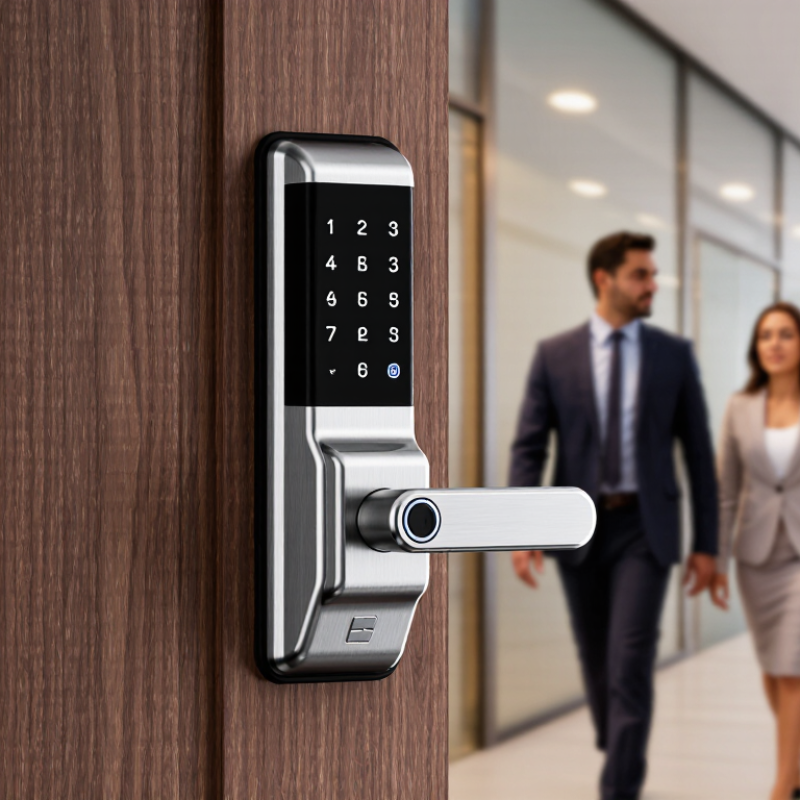
A commercial smart lock suits global buyers when it works across buildings, climates, and access policies. Fortune Business Insights reports that the global smart lock market may grow from about USD 2.49 billion in 2023 to USD 8.54 billion by 2032. Growth alone proves little. Procurement teams should check interoperability, certification, and long-term service support.
A suitable lock should support card, mobile, PIN, and mechanical override access. Offline operation matters. A hotel corridor cannot depend entirely on cloud connectivity. Look for clear audit trails, role-based permissions, encrypted communication, and secure firmware updates. Verizon’s 2025 Data Breach Investigations Report recorded a 34% rise in vulnerability exploitation. That makes cybersecurity testing a purchasing requirement, not a marketing feature. Regional data hosting and privacy controls also deserve careful review.
Physical performance is equally important. Buyers should verify IP ratings, temperature limits, corrosion resistance, battery life, and emergency power options. Standards such as ANSI/BHMA, EN 14846, and UL 294 may help, but local approval remains essential. A lock installed near a humid coastal entrance faces very different stress from one used in a dry office tower. In practical trials, I would test weak network coverage, repeated door slamming, and low-battery alerts. Small details matter. Yet no product fits every market perfectly. Total ownership costs, replacement parts, installer training, and regional technical support can still expose gaps after deployment.
| Commercial Lock Category | Typical Commercial Use | Primary Credentials | Connectivity | Typical Power Arrangement | Audit Capacity | Environmental Suitability | Global-Buyer Considerations |
|---|---|---|---|---|---|---|---|
| Wireless Electronic Lever Lock | Office rooms, education facilities, clinics and small commercial sites | PIN, RFID card, mobile credential and mechanical override | Bluetooth Low Energy; optional Wi-Fi gateway or mesh gateway | Alkaline or lithium batteries; commonly designed for several months to more than one year, depending on usage and communication mode | Typically 500–5,000 local events; cloud capacity depends on the management platform | Indoor use; outdoor suitability depends on the enclosure rating and temperature range | Check door-thickness range, latch compatibility, regional radio approvals and local fire-egress requirements |
| Hotel RFID Mortise Lock | Hotels, serviced apartments, student housing and managed accommodation | 13.56 MHz contactless cards, mobile credentials and emergency key or override | Offline card operation; optional Bluetooth and gateway-based online management | Usually battery-powered; emergency external power is commonly provided through a designated contact or port | Commonly stores several hundred to several thousand entry records, depending on the controller | Primarily indoor; select versions are available for humid or semi-outdoor environments | Confirm mortise dimensions, door handing, card technology, privacy functions and local accessibility rules |
| Networked Access-Control Reader with Electric Lock | Corporate buildings, factories, hospitals and multi-tenant properties | RFID credentials, PIN, mobile credential, biometric reader or QR credential | Ethernet, Power over Ethernet, RS-485 or wireless gateway, depending on system design | Centralized low-voltage power supply with battery backup recommended for critical doors | Typically managed centrally; event capacity is determined by the controller or cloud service | Indoor and outdoor readers are available; select a suitable IP rating for exposed locations | Best for centralized administration; verify wiring standards, PoE compatibility, emergency release and data-hosting requirements |
| IP-Rated Outdoor Smart Padlock | Utility cabinets, construction sites, warehouses, storage areas and remote equipment | Mobile app, PIN, RFID credential or temporary access code | Bluetooth Low Energy; optional cellular or gateway connectivity | Replaceable batteries; battery life varies substantially with temperature, use and network reporting | Often several hundred to several thousand events, subject to memory size | Select an enclosure rated at least IP65 for dust and water protection where conditions require it | Check corrosion resistance, freezing-temperature performance, shackle clearance and offline access behavior |
| Smart Cylinder Retrofit | Rental properties, offices and heritage buildings where the existing lock case should be retained | Mobile credential, PIN keypad, RFID accessory and existing mechanical key, depending on configuration | Bluetooth Low Energy; optional gateway for remote administration | Small replaceable batteries or rechargeable battery pack | Usually several hundred to several thousand local events | Indoor and protected outdoor versions are available; weather rating must be checked carefully | The cylinder profile is region-specific; confirm Euro profile, Scandinavian profile, rim-cylinder or other local format |
| Smart Intercom and Gate Controller | Apartment entrances, campuses, logistics yards and gated commercial premises | Mobile app, PIN, RFID, QR code, telephone call or visitor directory | IP network, Wi-Fi or cellular connection; relay output for compatible gate hardware | Fixed low-voltage supply with backup power recommended | Centralized event history; capacity depends on the controller and software subscription | Outdoor units should use an appropriate IP rating and protection against vandalism | Verify cellular bands, SIP or network compatibility, privacy laws, relay safety and local emergency-access rules |

Use the form below to drop us an email if you have any question or comments.